
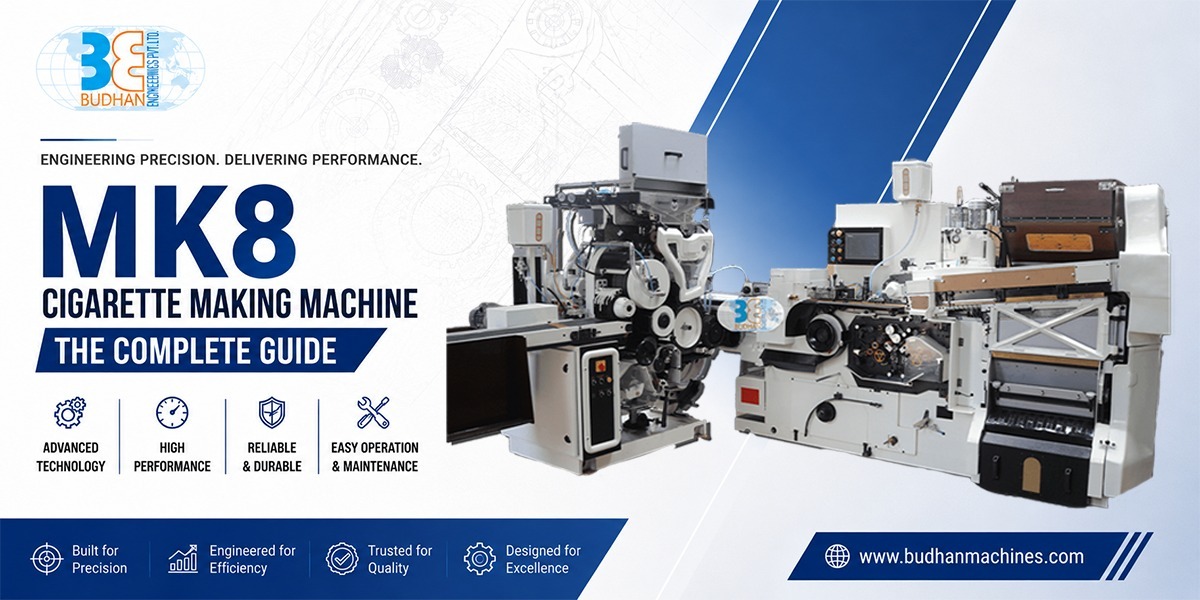
The MK8 cigarette making machine — also known as the Mark 8 is a fully automatic cigarette maker producing approximately 2,500 cigarettes per minute. It combines a cigarette maker, which forms and cuts the tobacco rod, with a filter assembler that attaches filter tips using cork tipping paper. It remains one of the most widely deployed cigarette-making platforms in the world.
If you are setting up a cigarette factory, replacing ageing equipment, or moving from hand-rolled to machine production, the MK8 cigarette making machine will almost certainly be on your shortlist. It occupies a position few other machines do: proven, serviceable, mechanically straightforward, and affordable enough to be a realistic first automated line, while still producing at genuine industrial volume.
This guide covers what the MK8 is, how it works, its full specifications, what determines its price, how it compares to faster machines, and one capability that matters enormously across Southeast Asia but is rarely discussed in English: running kretek clove blends without compromising the recipe.
What Is the MK8 Cigarette Making Machine?
The MK8 is an automatic maker-assembler system for filter cigarettes. Cut tobacco and cigarette paper enter at one end; finished, filter-tipped cigarettes leave at the other, at roughly 2,500 cigarettes per minute.
Budhan manufactures the MK8 in the Mark 8 D (double knife) configuration with a MAX-15 filter assembler and 1117 infeed unit — the arrangement most widely used for reliable 2,500 per minute output.
The Two Sections of an MK8 Line
The cigarette maker. Cut tobacco is fed through a hopper and distributed onto a continuous paper web running along the garniture. The tobacco is formed into a continuous rod, the paper seam is glued and sealed, and a cut-off knife divides the endless rod into uniform tobacco rods.
The filter assembler. Tobacco rods transfer to the assembler, where filter rod is cut, positioned between two tobacco rods, and joined using cork tipping paper. The assembled double-cigarette is cut at its centre, producing two finished filter cigarettes.
The two sections operate as one continuous line, which is why the MK8 is described as a fully integrated maker-assembler rather than a rod maker alone.
Who the MK8 Is Built For
The MK8 suits manufacturers who need dependable industrial output without the capital cost and technical complexity of ultra-high-speed lines. Typical buyers include:
- New cigarette factories commissioning their first automated production line
- Manufacturers moving from hand-rolled to machine-made production
- Established factories adding capacity or commissioning a second line
- Producers in markets where spare-part availability and straightforward mechanical service matter more than maximum theoretical speed
- Kretek producers who need a machine capable of handling oily, heavy clove blends
It is less suited to very large-scale operations already running well above 5,000 cigarettes per minute, which are better served by higher-speed platforms.
MK8 Technical Specifications
The MK8’s configuration is flexible and can be adapted to your tobacco blend, paper, and target cigarette format. The tables below reflect the standard Budhan build.
Maker Specifications
| Specification | Detail |
| Overall capacity | Approximately 2,500 cigarettes per minute |
| Machine speed range | 2,000 – 2,500 cigarettes per minute |
| Configuration | Mark 8 D (double knife), MAX-15, 1117 infeed unit |
| Cut-off speed | Approximately 2,500 r/min |
| Filter cigarette length | 59 – 100 mm |
| Rod cigarette length | From 45 mm |
| Rod cigarette diameter | From 5.4 mm |
| Filter length | From 66 mm |
| Filter tip length | From 11 mm |
| Filter tip diameter | From 5.35 mm |
| Filter tip attachment | 6 UPS / 4 UPS |
| Seam glue | PVA or hotmelt |
| Weight control system | Microwave (optional) |
| Printer at rod maker | 1 colour, 2 colours, or with bronze box |
Control, Power and Physical Specifications
| Specification | Detail |
| Control system | Delta PLC with HMI touch display |
| Power supply | 3-phase, configured to the destination country’s supply |
| Frequency | 50 Hz ± 1 Hz |
| Air pressure | Approximately 4 bar |
| Maker weight | Approximately 3,500 kg |
| Filter assembler weight | Approximately 1,500 kg |
A Note on Speed Claims
You will see MK8-type machines advertised at speeds far above 2,500 per minute. Treat those claims carefully.
The Mark 8 platform is a proven mid-speed machine, and approximately 2,500 cigarettes per minute is its realistic, sustainable production rate. Machines genuinely quoted at 6,000 to 8,000 per minute are entirely different platforms, at several times the capital cost. A supplier who inflates the speed figure on a Mark 8 is telling you something useful about how they will handle the rest of the relationship.
How the MK8 Works: The Production Process Step by Step
Understanding the process helps you evaluate any supplier’s machine, and helps your team plan installation, training and maintenance.
Stage 1: Tobacco Feed and Distribution
Cut tobacco enters the hopper and is metered into the distribution system, which delivers an even, continuous stream to the rod-forming section.
Consistency here determines consistency everywhere downstream. Uneven feed produces uneven fill weight, which shows up in the finished product as loose ends, variable draw resistance, and customer complaints.
Stage 2: Rod Forming on the Garniture
Cigarette paper is drawn from the bobbin and runs along the garniture, where the tobacco stream is compressed and wrapped into a continuous rod. The paper seam is glued — with PVA or hotmelt — and sealed as the rod travels.
Stage 3: Weight Control
Optional microwave weight control continuously monitors rod density and feeds corrections back to the tobacco feed system, holding fill weight within tolerance.
On blends that vary in moisture or density, this is worth specifying rather than treating as an optional extra. It pays for itself in reduced waste and more consistent product.
Stage 4: Cut-Off
The double-knife cut-off divides the endless rod into individual tobacco rods at the required length. The “D” in Mark 8 D with MAX-15 refers to this double-knife arrangement.
Stage 5: Transfer to the Filter Assembler
The 1117 infeed unit transfers tobacco rods into the MAX-15 filter assembler, maintaining correct orientation and spacing throughout the handover.
Stage 6: Filter Cutting and Tipping
Filter rod is cut to length and positioned between two tobacco rods. Cork tipping paper is applied and wrapped, bonding the filter to both rods simultaneously.
Stage 7: Final Cut and Delivery
The assembled double-cigarette is cut at its centre, producing two finished filter cigarettes, which are delivered to the catcher for collection or onward transfer to a tray filler or packer.
Why a 1959 Design Is Still in Production
The Mark 8’s longevity is not sentimentality. It is a consequence of how the machine was engineered.
A Mark 8 can be diagnosed, adjusted and repaired by a competent maintenance team without proprietary diagnostic tooling or a service contract with the original manufacturer. Its mechanics are comprehensible and its wear parts are replaceable. In markets where downtime is expensive and specialist support is distant, that is a decisive practical advantage over machines that must be serviced by the manufacturer.
The platform survived because it solves a real problem: delivering genuine industrial output from equipment a factory can actually maintain itself.
Budhan manufactures new machines built to this proven Mark 8 design. Budhan is an independent manufacturer and is not affiliated with, endorsed by, or an authorised agent of Molins or the Coesia Group.
Kretek Production: Running Clove Tobacco Without Compromising the Blend
This section matters most to manufacturers in Indonesia and other kretek markets, and it addresses a limitation the industry has quietly accepted for decades.
Why Kretek Is Difficult for Cigarette Machinery
Kretek — the clove and tobacco blend that accounts for roughly 90% of cigarettes smoked in Indonesia — behaves very differently inside a kretek cigarette making machine from flue-cured or Virginia blends.
Clove is rich in eugenol, the aromatic oil that gives kretek its characteristic flavour and its distinctive crackle when burning. That oil, combined with the sugars and casings typical of kretek recipes, produces a cut tobacco that is oilier, stickier, heavier and often higher in moisture than the blends most kretek cigarette making machines were designed around.
Inside a standard cigarette maker, those properties cause cumulative problems:
- Residue builds up on the garniture and tape
- Cut-off knives gum up, requiring more frequent cleaning and sharpening
- Tobacco adheres and bridges in the hopper and distribution system
- Fill weight becomes inconsistent as denser, damper tobacco flows differently
- Oils interfere with glued and bonded surfaces
- Contact surfaces wear faster
- Cleaning stops become more frequent, and effective uptime falls
None of these are dramatic failures. They are a steady tax on production — a machine that needs stopping more often, cleaning more thoroughly, and adjusting more frequently than the same machine running a conventional blend.
The Compromise the Industry Has Accepted
The standard workaround is revealing.
Machine-made kretek producers routinely reduce the clove-to-tobacco ratio specifically to prevent clogging. Hand-rolled kretek can carry a higher clove ratio precisely because no machine has to survive it. The machine-made version is adjusted to suit the equipment’s limitations.
In other words, the industry has been compromising the defining characteristic of the product in order to keep the machinery running.
The Budhan Approach to Kretek
Budhan configures and modifies the MK8 specifically for kretek production, so the machine runs oily, heavy clove blends smoothly.
The objective is straightforward: you should be able to produce the blend your market actually wants, at the clove ratio your recipe calls for, without adjusting it downward to protect the machine.
We have built this capability into machines for clove-blend producers, and we configure each machine to the customer’s specific blend, clove ratio and moisture profile rather than supplying a single standard build and hoping it copes.
If you produce machine-made kretek — full flavour, light mild, or a new brand in development — talk to us about the blend you actually want to run, not the one you have been running because of the equipment.
Why This Matters Commercially
Machine-made kretek, known in Indonesia as SKM (sigaret kretek mesin), has decisively overtaken hand-rolled kretek, SKT (sigaret kretek tangan).
Industry figures have put SKM volume at roughly 199 billion sticks against 60 billion for SKT, and the gap has continued to widen as manufacturers shift production from hand-rolling to machines. That shift is driven by labour costs, consistency, and the ability to produce filtered products at scale.
It also creates a specific requirement: machines that can produce authentic kretek at industrial volume without diluting what makes it kretek. A maker that handles the real blend protects your product’s character while giving you machine economics — rather than forcing you to choose between them.
New Machines vs Rebuilt Machines
A large share of the MK8 machines on the world market are used, rebuilt or reconditioned original Molins units, many of them decades old. They are offered at attractive prices, and for some buyers they work out. But you should understand exactly what you are being offered before comparing prices.
Budhan supplies brand-new machines only. Not refurbished, not reconditioned, not rebuilt.
What “Brand New” Actually Means
- A known service life. A new machine starts at zero hours. A rebuilt machine may have run for decades, and wear in castings, shafts and bearing housings is not always visible in a refurbishment.
- Integrated modern controls. Budhan machines are built with Delta PLC and HMI touch-screen control as part of the original design, not older electronics retrofitted onto an ageing frame.
- Consistent, documented build. Every machine is manufactured to the same specification, so a second or third line matches the first — which matters for operator training, spare parts and maintenance procedure.
- Predictable spare parts. Parts are manufactured to a current, documented specification rather than sourced for equipment built two generations ago.
Questions to Ask Before Buying a Rebuilt MK8
If you are weighing a rebuilt machine against a new MK8 cigarette machine, ask for the following in writing. A straightforward supplier will provide it without hesitation:
- What year was the machine originally manufactured?
- What are its total operating hours?
- Which components were replaced during refurbishment, and which were retained?
- What warranty is offered, and what does it exclude?
- Are spare parts available, and from what source?
- Can the machine be inspected under power, running, before purchase?
Then compare total cost of ownership rather than purchase price. A cheaper machine that loses production days to breakdowns is not cheaper.
Integrating the MK8 Into a Complete Production Line
A cigarette maker is one stage in a longer process. Budhan manufactures the complete line, which means matched throughput and a single point of accountability for installation, training and service.
| Stage | Machine | Function |
|---|---|---|
| Making | MK8 with MAX-15 | Forms tobacco rods and attaches filters |
| Packing | Budhan Packer HLP2 | Hinge-lid hard pack packing |
| Wrapping | Budhan Wrapper 300 | Film overwrapping of packs |
| Stamping | Budhan Tax Stamper | Applies tax and excise stamps |
| Boxing | Budhan Boxer | Packs into cartons |
| Carton wrapping | Budhan Over Wrapper | BOPP film overwrap on cartons |
| Support | Spare Parts | Ongoing parts supply across the line |
Sourcing the line from a single manufacturer avoids the most common problem in mixed-supplier factories: mismatched throughput, where a fast maker feeds a slower packer and the bottleneck consumes the capacity you paid for. It also removes the diagnostic finger-pointing that occurs when three suppliers each attribute a fault to another company’s machine.
What Determines the Price of an MK8 Machine
Industrial cigarette machinery is quoted rather than listed, because specification drives price and MK8 specifications vary widely. Here is what actually moves the figure.
Machine Specification
- Format range and the change parts required
- Weight control system, if specified
- Printing configuration at the rod maker
- Kretek or specialty-blend configuration
- Control and HMI options
Scope of Supply
- Maker and assembler alone, or a complete production line
- Installation and commissioning
- Operator and maintenance training
- Initial spare-parts package
- Shipping, insurance and destination
Total Cost of Ownership
This is the figure that actually determines what a machine costs you. It includes energy consumption, maintenance and wear parts, consumables, expected uptime and waste rate.
A machine with high uptime and a low waste rate will outperform a cheaper machine with frequent stoppages, often within the first years of operation. Purchase price is the smaller half of the calculation.
Getting an Accurate Quote
To receive a meaningful quotation from any supplier, provide:
- Target output
- Cigarette format or formats
- Tobacco blend, including clove ratio if producing kretek
- Destination country and power supply
- Whether you require the complete line or the maker alone
MK8 vs MK9 vs High-Speed Makers: Choosing Correctly
| MK8 / Mark 8 | MK9 / Mark 9 | High-speed platforms | |
|---|---|---|---|
| Output | Approximately 2,500/min | Higher than MK8 | Substantially higher |
| Best suited to | First automated line; small to medium factories | Factories outgrowing the MK8 | Large-scale, high-volume operations |
| Mechanical complexity | Straightforward and serviceable | Moderate | High; specialist support required |
| Relative capital cost | Lowest | Medium | Highest |
| Spare-part availability | Widest | Good | Manufacturer-dependent |
When the MK8 Is the Right Choice
Choose the MK8 if you are entering automated production, running small to medium volumes, operating in a market where straightforward mechanical service is an advantage, or producing specialty blends such as kretek where machine adaptability matters more than raw speed.
When to Consider a Faster Machine
Consider a higher-speed platform if you are consistently running an existing line at full capacity and have the market volume, technical staff and capital to support it.
Buying more speed than your market absorbs is a common and expensive mistake. A machine running at 40% of its capacity has not earned its additional cost — it has tied up capital and increased the maintenance burden without returning anything.
Installation, Training and After-Sales Support
Machinery is only as good as the support behind it, particularly when your factory is thousands of kilometres from the manufacturer. Budhan provides:
- On-site installation and commissioning
- Operator training for your production team
- Maintenance training for your technical staff
- Technical manuals and documentation
- Spare parts supply across the full product range
- Ongoing technical support by phone and WhatsApp
Export Markets
Budhan is based in Hyderabad, India, and exports cigarette making machines and packing machinery worldwide, handling export documentation, logistics and on-site commissioning.
We supply cigarette making machine manufacturers across Southeast Asia including Indonesia, the Philippines and Bangladesh; South Asia including India and Pakistan; the Middle East including the UAE and Turkey; Africa including South Africa, Tanzania, Zambia and Angola; and further markets across Europe, Central Asia and the Americas.
Frequently Asked Questions
How many cigarettes per minute does the MK8 produce?
Approximately 2,500 cigarettes per minute, with a typical operating range of 2,000 to 2,500.
What is the difference between the MK8 and the Mark 8?
They are the same machine. “Mark 8” is the original model name introduced by Molins in 1959; “MK8” is its common abbreviation. Both terms are used across the industry.
What configuration is the Budhan MK8?
Mark 8 D, the double-knife configuration, with a MAX-15 filter assembler and 1117 infeed unit.
Are Budhan MK8 machines new or refurbished?
Brand new only. Budhan does not supply used, rebuilt or reconditioned machines.
Is the Budhan MK8 a genuine Molins machine?
No. Budhan is an independent manufacturer producing new machines built to the proven Mark 8 design. Budhan is not affiliated with or endorsed by Molins or the Coesia Group.
Can the MK8 produce kretek clove cigarettes?
Yes. Budhan configures the MK8 specifically for kretek production, so it runs oily, heavy clove blends smoothly — without requiring you to reduce the clove ratio to prevent clogging.
What is the difference between the MK8 and the MK9?
MK8 vs MK9: The MK9 is the faster successor generation, introduced by Molins in 1972. The MK8 produces approximately 2,500 cigarettes per minute at lower capital cost, with simpler service requirements and wider spare-part availability.
Does the MK8 include a filter assembler?
Yes. The MK8 is supplied as an integrated maker and filter assembler, using the MAX-15 assembler with 1117 infeed unit.
Can the MK8 run on my country’s power supply?
Yes. The three-phase supply is configured to your country’s voltage and frequency.
How much does an MK8 cigarette making machine cost?
Price depends on specification, condition and scope of supply. Budhan quotes against your specific requirements — contact us with your target output, cigarette format, blend and destination country for an accurate figure.
Do you provide installation and operator training?
Yes. We provide on-site installation and commissioning, operator training, maintenance training and full technical documentation.
Do you supply the complete production line?
Yes. Budhan manufactures the maker, packer, wrapper, tax stamper, boxer and over-wrapper, together with ongoing spare parts supply
About Budhan Engineerings
Budhan Engineerings has manufactured cigarette making and packing machinery from Hyderabad, India for over four decades, supplying new machines and complete production lines to manufacturers worldwide. Our facility spans 30,000 square feet and employs a team of skilled technical professionals dedicated to machine build quality, commissioning and after-sales support.
If you are evaluating an MK8 — whether for standard filter cigarettes or for kretek production — tell us your target output, cigarette format, tobacco blend and destination country, and we will provide a specification and quotation configured for your operation.
Budhan Engineerings Private Limited Plot No 30/A IDA, Balanagar, Hyderabad, Telangana 500037, India Telephone: +91 9533355111 · +91 99635 04477 Email: info@budhan.com

